Friday, March 27, 2009

What are Peltiers?

In any electronic circuit, keeping the components cool is very important from the point of view of reliability. With a small increase in temperature, the reliability goes down exponentially. Most electronic components show a degradation in performance with increase in temperature. While many of the components can keep their cool all by themselves, some of the power-hungry components cannot do without heat-sinks to efficiently remove the heat within. This is what you call passive cooling. When the ambient temperature in the vicinity of the electronic component is high enough not to allow any appreciable heat transfer from the heat sink to the surrounding air, one has to go in for active methods of cooling. Using a Peltier - also known as a Thermo-Electric Cooler (TEC) - is one such method.

A Peltier, as shown in the above pictures, has two surfaces. On forcing a DC current through a Peltier, it removes heat from one surface and passes it on to the other. Quite obviously, the first surface becomes cold while the other becomes hot. I can now place my electronic component on the cold side and a large heat-sink on the hot-side so that I have a neat way to pump out heat from the component. And yes, a thermodynamics guy would call such a device a heat pump.

The underlying principle - known as the Peltier Effect - is elegantly illustrated in the animation below [source: www.peltier-info.com]
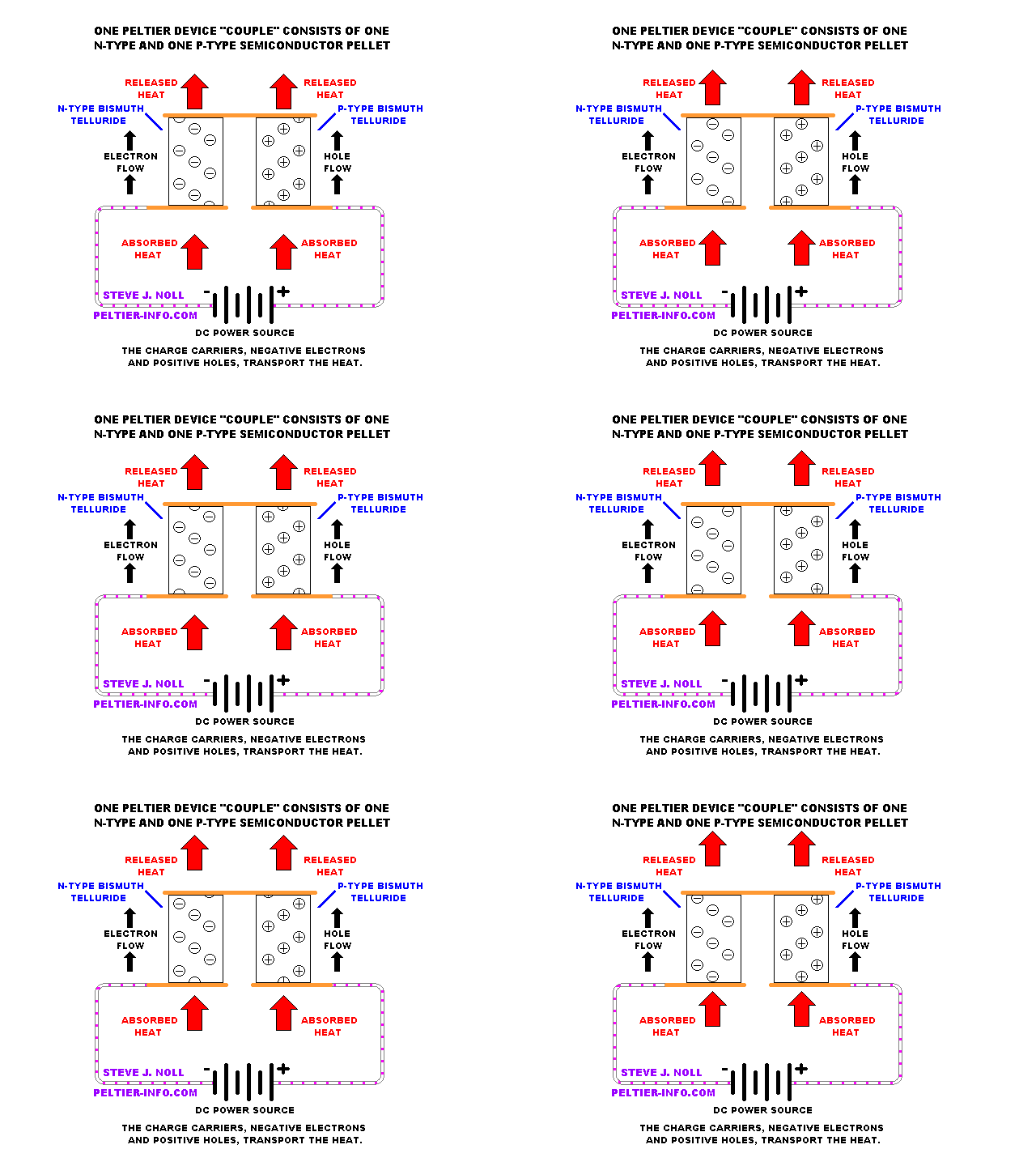
While Peltiers can do an important job for you inside a high-end PC, especially if you are an over-clocker, they can also provide good amusement value if you wanted to freeze a few drops of water in a few seconds! I tried it out one sunny day with a solar panel driving just over an ampere of current through a small Peltier element mounted on a heat-sink. (You could as well use a good DC supply to drive your Peltier. But it certainly is funkier to use solar energy to freeze water!) It is advisable to apply a small amount of thermal grease between the Peltier and the heat sink to get better thermal conductivity. After making the connections, initially water vapour condenses over the cold surface and then freezes within a few minutes, if not seconds. Using a fan, taking hot air away from the fins, I got even better results. Under laboratory conditions of 26 degree celsius, a cold side temperature of -7 degree celsius was achieved! And yes the heat sink became quite hot, say 40-45 degree celsius. As the heat sink becomes hotter, the achieveable cold side temperature also goes up. This is where a larger heat sink helps as it will take a very long time to become hot. One more interesting thing. If you see that all of a sudden all the ice melts, it is mostly due to a passing cloud shading your solar panel :-)

Paul Peng gives a very neat and descriptive account of his experience with Peltiers on this page. And here's a video demonstration of the Peltier Effect:


One could ask, why dont people use Peltiers in refrigerators. The answer is Peltiers are expensive and yet quite inefficient. Cycling a refrigerant through a compressor, a condenser, an expansion valve and an evaporator (Refrigeration Cycle) is a far cheaper and more efficient way to cool our food stuff. But when it comes to meeting the cooling requirements in a small area and in a highly reliable fashion, nothing beats the Peltiers. After all, Peltiers are completely solid state devices with no moving parts.

Wednesday, November 26, 2008

Cell phone that lasts a month

While I was watching India trash England - yet again - in the fifth ODI at Cuttack, something quite interesting sprang up in a commercial break. It wasn't a very aesthetically made advertisement. But it did catch my attention. The product in question is a cell phone that supposedly needs to be charged only once in a month! It's called the Micromax X1i. Powered by an 1800 mAh Li-ion battery, it has a standby time of 30 days and a talk time of 17 hours. It's also capable of playing MP3 music offline for 16 hours. All this for a lowly Rs 1999. That's quite an achievement for a completely indigenous company though, I agree, there would be some unavoidable skepticism towards the claims. The user manual says that it may take up to 30 minutes before the battery icon/charging icon appears on the screen when charging. I hope that doesn't mean that the battery wasn't being charged in those 30 minutes. Anyway, here's a sneak peek at its sleek looks.

For more information, visit http://www.micromaxinfo.com/products/x1i.html


Saturday, October 25, 2008

Ceiling fans can do better


A typical 75 W-input ceiling fan only generates about 15 W of mechanical power, making it only 20% efficient. The balance of 60 W is dissipated as heat.  Winner of Farnell’s Live EDGE design contest, John Nobel identified this problem and tried to solve it. He designed a product called MyFan, a ceiling fan that combines an electronically commutated motor and controller, and aerodynamically efficient blade design that reduces fan input power by up to 66 percent of that of a traditional ceiling fan. In other words, the new design is three times as efficient as the conventional design. It boasts auxiliary output channels that drive up to 20 watts of integrated LED lighting with up/down lighting modules. The motor construction is totally enclosed and is available with an IP5x environmental rating. Here's an article that highlights the achievement. 
Ceiling fan design promises reduced power consumption

Recently chosen as the grand prize winner of distributor Premier Farnell’s Live EDGE design contest, a ceiling fan dubbed MyFan by designer John Noble combines an electronically commutated motor and controller with an aerodynamically efficient blade design to promise input-power reductions of up to 66% over traditional ceiling fans. Noble, a Malaysia-based design engineer, came up with the idea in early 2007, before he even heard about the contest, which he ultimately found out about the through Farnell’s Web site while placing an order in May 2007.

Premier Farnell CEO Harriet Green presents a $50,000 check to John Noble, winner of Farnell’s Live EDGE design contest.

On hiatus from his job, Noble had been pondering how to move his career toward efforts that were more socially or environmentally focused. The answer, as it turned out, was closer than he knew.

“In our house we have nine ceiling fans, and at any time of the day or night there are at least three of those running,” he said. “Quite literally the first thing see every morning when I wake up is a ceiling fan. One morning I woke up and decided I should have a closer look.”

While ceiling fans have been on the market for over 100 years, their motor design has really changed very little. And current fans are terribly inefficient. According to the award-winning designer, a typical 75-W-input ceiling fan only generates about 15 W of mechanical power, making it only 20% efficient. The balance of 60 W is dissipated as heat.

A fan constructed with modern components—specifically electronically commutated motors—has an efficiency of about 60% reducing input power to about 25 W to offer drastic power-consumption reduction.

Noble’s research shows that in the United States alone, there are about 158 million ceiling fans installed consuming 150 petajoules (PJ) annually. Fans designed with the high-efficiency ac motors can reduce that by about 100 PJ and eliminate 14 million metric tons of CO2 emissions.

While the technology could be applicable for other types of fans, this particular design is focused on the specific characteristics of ceiling fans. “It is a relatively low-absolute-power module that generates quite high torque at low speeds,” Noble said. “Generally, industrial fans tend to operate at higher speeds and draw more power.”

Suprisingly, Noble used Microsoft Excel for the bulk of the design effort. “I do most of my electronic circuit analysis actually using Excel, which now has a wide range of features that allow very good simple numerical analyses to be done,” he said. “I did 3-D and mechanical design using Alibre Design Software, I used a company called Field P for doing magnetic field simulation, and circuit-schematic capture and PCB layouts are done on [Altium’s] Protel.”

Premier Farnell plans to present another design contest for 2008. For more information about the contest, visit http://www.premierfarnell.com.

Ralph Raiola


Using advanced motor control algorithms such as field-oriented control or vector control could further improve the efficiency, though I'm not sure whether Nobel's design already incorporates such an algorithm. The Indian fan market is estimated at 2.5 million fans per month and it is growing at about 10% per annum [1]. Also, there are currently several millions of fans that have percolated down to the millions of households in India. Incorporating energy efficiency into them could lead to huge savings in power. The Bureau of Energy Efficiency (BEE) in India is to shortly issue a notification suggesting raising of energy efficiency parameters for fans manufactured in the country. The implementation of the new standards would help save between 15 and 20 per cent electricity in new fans while conserving over 30,000 MW of electricity over the next five years in the country[2]. We can do even better if we were to take a cue from Noble's work. Is there an enterprising entrepreneur somewhere who's listening?

Friday, October 10, 2008

First Day At The Cleanroom


A cleanroom is an environment, typically used in manufacturing or scientific research, that has a low level of environmental pollutants such as dust, airborne microbes, aerosol particles and chemical vapors. It has a controlled level of contamination that is specified by the number of particles of size 0.5µm or larger permitted per unit volume of air.  For example, a Class-100 cleanroom would have 100 particles of size 0.5µm or larger per cubic foot of air.  Cleanrooms are used extensively in semiconductor manufacturingbiotechnology, the life sciences and other fields that are very sensitive to environmental contamination. 

At IISc, we have a Class-10,000 cleanroom at the Centre for Electronics Design and Technology (CEDT) and Class-100 and Class-1000 cleanrooms at the Department of Electrical Communication Engineering (ECE). The upcoming Centre of Excellence in Nanoelectronics (CEN) is currently building a state-of-the-art nanofabrication facility with a clean room spanning 1400 square meters.

Today, I visited a cleanroom for the second time in my life.  The first time was about four years back when I happened to visit Astra Microwave Products Limited, Hyderabad. The company specializes in communication products for space and defence applications. Then I had little idea about what goes on inside and I was just - so to say - a lay visitor. Today, I entered the cleanroom at CEDT as - I'd love to believe - a well-informed graduate student. The task was a simple one - fabricating a rather unflattering single-sided Printed Circuit Board (PCB). It might not be a big deal, I suppose, with the latest technology moving towards multi-layer boards with microvias and embedded passives. But it was a learning experience to get a first-hand idea of the process steps involved. Chances of me getting involved in PCB fabrication or, for that matter, IC fabrication are remote. Yet, the Electronic System Packaging course here at CEDT has provided me with an opportunity to get a sneak peek at this relatively unglamourous side of the electronics industry. There's more to learn in the coming months.