
"It seems necessary to me, then, that all people at a session be willing to sound foolish and listen to others sound foolish." ~Isaac Asimov in his essay titled On Creativity
Most researchers are learners trying to understand their field, and beyond, as best as they can using the tools at their disposal. But of course research is about pushing the frontiers of knowledge a tad outside of what is already known to humanity. This is beautifully expounded as a dent in the circle of human knowledge in The Illustrated Guide To A Ph.D. by Matt Might, University of Alabama at Birmingham. Although Might's depiction shows this phenomenon in an academic context where the game is explicitly sytematised, a lot of people are (often anonymously) denting the circle outside of the typical grad school setting and without the fancy hats and badges. In our efforts to make those dents, we are always on the lookout for ways to generate new research ideas.
The central question then is: How can I come up with an idea that no human has come up with before? I cannot seem to will them into existence, ideas seem to come out of the blue, often at odd times. In most cases, after arriving on an idea, the initial feeling of triumph is promptly damped by a Google search that throws up a 1990s paper (hopefully not earlier) that already proposed the idea, and they probably went above and beyond what you had envisaged. No wonder, the key to having good and new ideas is to have many many ideas—harness the power of combinatorial success. If we need so many ideas, what are our methods for idea generation? I thought of compiling a few of my tricks here so I can come back to it when I am sans inspiration. May be some of these work for you too.
1. Combine two (or more) disparate ideas
Entrepreneur and leadership speaker Joel Hilchey says, "Many new ideas come from combining two distinct ideas. E.g. combining a phone and a computer, we have a smartphone." He has a point. The process of ideation is a lot like chemistry. Ideas are like atoms and molecules. We come up with new ideas by bringing together and combining existing ones. If you have a lot of 'elementary ideas' and you keep shuffling them around, rearranging them in different ways, ultimately some of them will naturally snap together to form new ideas. You can then further explore these newly formed compound ideas putting them under the microscope to discover their properties and potential. Some tools that facilitate this task of continuously rearranging ideas are writing, making tables and lists, drawing graphs and curves (by hand AND by computers), mind-maps, sorting your notes by keywords (Tiddlywiki is excellent for this), and of course the good old Socratic method with an honest interlocutor.
Another good way of ensuring regular combinations of disparate ideas is for an individual to have at least two fields of study, say a major and a minor, and to keep smuggling ideas from one field to the other. As an engineer, a clear manifestation of this method is 'from science lab to engineering lab'. Take recent scientific advances and use them in engineering applications. These could be new devices, components, materials, configurations etc. E.g. Robert Middlebrook took William Shockley’s transistor idea, and used it in circuits to spawn the area of power electronics—which is central to technologies like renewable energy, electric vehicles, and smart grids today. This 'translation story' is laid out in illuminating detail in a 1998 Middlebrook interview by K. Kit Sum. Another stalwart in power electronics, Fang Z. Peng from Michigan State University, sometimes recruits grad students with absolutely no background in power engineering citing the rationale, “Great ideas in a particular research area come from outside the field.”
We've been focusing on bringing together separate fields of study in our quest for new ideas. Sometimes, however, theoretical and practical aspects of the SAME field can get siloed into being like separate fields. This is where opportunity is rife for switching back and forth between the two sides in order to shuttle ideas. Make the divide between industry and academia porous. If you are not yourself able to switch sides, invite people over from the other side. Build bridges, open doors.
2. Marry complementary problems
A bad effect of one system can serve as a good effect for another system. Put them together to get integrated solutions. E.g. Cooling requirements are highest when it is sunniest i.e. the available solar energy is maximum. Hence explore solar-powered air-conditioning, and solar-driven peltiers for cooling photovoltaic cells. Food for storage needs cooling while a home, or at least its water supply, might need heating. Instead of investing resources separately into each of these problems, what is a good way to integrate their complementary needs into a single solution? I go crazy when I see my refrigerator working hard to keep my ice-cream frozen while the room-heater tries to heat the space around the refrigerator.
Sometimes, it is easier to solve multiple problems with one solution. E.g. shifting to a largely active transportation model, à la Amsterdam, consisting of short-distance trips of walking and biking simultaneously addresses the issues of air pollution, public health, road accidents, and climate emergency. This is the kind of problem solving approach that Elizabeth Sawin calls multisolving. Like the bridging approach of #1 above, multisolving also entails talking to researchers in other fields about the key problems they are trying to solve.
Another way of looking at multisolving is to “overload” existing systems. If something already exists, what can it do in addition to what it was designed to do? Sometimes, with just small modifications, we can make existing systems and components do additional tasks. E.g. (1) Using WiFi to serve as an indoor GPS; (2) Using the motor-drive power converter circuit of an electric vehicle as battery charger.
Another way of looking at multisolving is to “overload” existing systems. If something already exists, what can it do in addition to what it was designed to do? Sometimes, with just small modifications, we can make existing systems and components do additional tasks. E.g. (1) Using WiFi to serve as an indoor GPS; (2) Using the motor-drive power converter circuit of an electric vehicle as battery charger.
3. Measure everything, then infer
New eyes. This is what a rich variety of sensors and instrumentation allow us today. Observe the system under study from different perspectives, then look at the data to hopefully tell things about its health and surroundings that were previously unknown. Often this involves bringing in types of measurement instruments not typically associated with your system under study. E.g. Electronics engineers are used to probing circuits with multimeters, oscilloscopes, and (for the wealthy ones) spectrum analyzers. How about microphones? Based on audible sound signature of a motor or other electro-magnetic device, can we infer something about the health and/or operating mode? A related tip for young electronics engineers from ISRO's Manoj R. Iyer is to use current probes as we often tend to get locked into using only voltage probes seeing only voltage waveforms. Taking this new-eyes idea into creepy territory, MIT researchers found a way to decipher what someone is speaking based on the vibrations on a Lay’s chips packet near the person.
4. Classify and tabulate
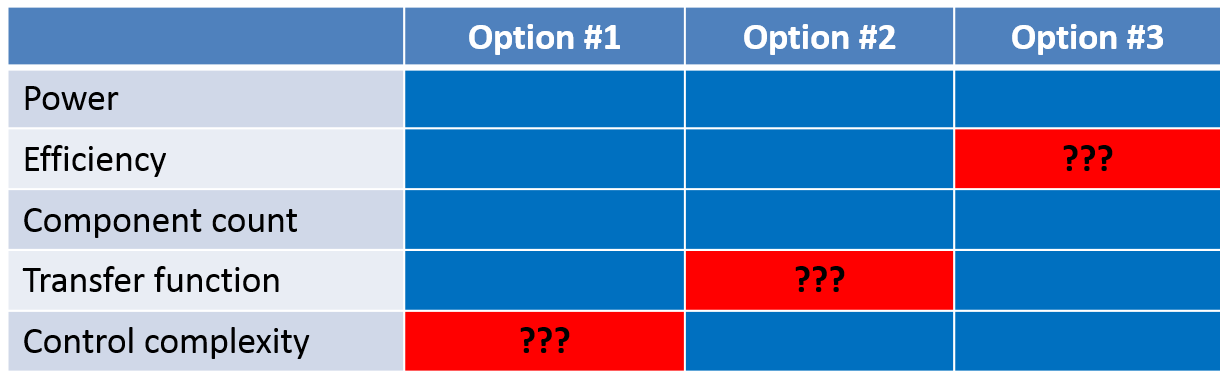
I briefly brought this up in #1 above, but the classify-and-tabulate method probably merits a separate mention on its own. This has been a powerful tool from the beginning of science as many humans derive cathartic pleasure in arranging things systematically (Marie Kondo likes this) and then looking for hidden patterns. Exhaustive classification and tabulation provides a bird’s eye view of the field and easy comparison of normally scattered pieces of information by the simple act of juxtaposition. A table tells us what are the things we know quantitatively and what we know qualitatively. A table is a powerful tool for locating gaps in knowledge as depicted below. This is perhaps why you would find lots of tables in technical texts even though we have more aesthetic tools like graphs and plots.
5. Draw waveforms and plots by hand
With the ubiquitous computers and simulation tools, it is easy to let them do all our plotting. While that is widely used for good reason, I would draw attention to drawing waveforms and other plots by hand. Drawing by hand makes you think in ways that simulation doesn't, simply because the latter is sometimes a bit like watching a football match rather than playing it. Drawing by yourself is akin to running your own mental simulation. Let us say you try to draw an XY plot. Immediately you have to first label the axes and think about the typical range of numbers for each axis for the chosen units. As you put down the pen on paper, where do you start and end the curve? What are the initial conditions and boundary conditions that define the constraints for what you draw. What is the slope in different parts of the curve? You will need to know about dynamics, rate of change, and sensitivity. Is the function monotonic, is it continuous, is it differentiable? As you put ink on the seemingly dead piece of paper, it comes alive with many questions. You are having a rich conversation with dead plant tissue.
6. Eye for detail
The prolific Isaac Asimov wrote these insightful lines: "The most exciting phrase to hear in science, the one that heralds new discoveries, is not 'Eureka!' but rather, 'hmm... that's funny...'" While it is easy to look for things that you want to see, seek out details that are not as per your expectation even if they are fleeting. That is where new ideas and potential problems hide. The Davis Dictum says, "Problems that go away by themselves come back by themselves." There is this category of bugs that show up only intermittently and are hard to reproduce. These types of bugs are the toughest little scoundrels to understand and debug. And often, their genesis lies in the ignored details that have always been there, albeit not always in plain sight. And so, keep an eye for detail not just in your mind put perhaps also in your notes and reports. Further expanding this 'tell everything, hide nothing' philosophy, Richard Feynman writes in 'Surely You're Joking, Mr. Feynman!':
“If you’re doing an experiment, you should report everything that you think might make it invalid—not only what you think is right about it: other causes that could possibly explain your results; and things you thought of that you’ve eliminated by some other experiment, and how they worked—to make sure the other fellow can tell they have been eliminated. Details that could throw doubt on your interpretation must be given, if you know them. You must do the best you can—if you know anything at all wrong, or possibly wrong—to explain it. If you make a theory, for example, and advertise it, or put it out, then you must also put down all the facts that disagree with it, as well as those that agree with it. There is also a more subtle problem. When you have put a lot of ideas together to make an elaborate theory, you want to make sure, when explaining what it fits, that those things it fits are not just the things that gave you the idea for the theory; but that the finished theory makes something else come out right, in addition. In summary, the idea is to try to give all of the information to help others to judge the value of your contribution; not just the information that leads to judgment in one particular direction or another. The first principle is that you must not fool yourself—and you are the easiest person to fool.”
7. Old books, new ideas
Research today tends to fall into the habit of limiting itself to recent references, and clean and searchable PDFs. There are many brilliant ideas in old books and documents. When I say old, I mean yellowed-pages old, possibly even tattered. Some of these ideas might have died because the context in which they came up was not conducive, or because there weren't tools to implement them. Delve into the archives, and this will perhaps also make you a steward for their preservation. This is why I have great respect for libraries, and online archives like Internet Archive and Project Gutenberg. In his book Chaos, James Gleick writes about physicist Albert Libchaber:
"His colleagues joked about his obsession with old books. He had hundreds of original editions of works by scientists, some dating back to the 1600s. He read them not as historical curiosities but as a source of fresh ideas about the nature of reality, the same reality he was probing with his lasers and his high-technology refrigeration coils."
8. Ideas from the trashcan
Outside my office at CERN, there is an e-waste trashcan. Hardware aficionados are often seen digging into these bins like sea gulls in search of a prize catch. Some of the kaput gizmos there are quite old and rare. Leaving aside their antique value, a piece of broken equipment is an invitation to read the designer's mind. What made them chose these components placed in that particular configuration? What were the limits of the technology of the day? Can it be repaired? Are there parts of the system that would still work perfectly well? What can you salvage from these tech fossils? As the legendary analog designer Jim Williams puts it, "The inside of a broken, but well-designed piece of test equipment is an extraordinarily effective classroom." The trashcan also inspires me to practice my French (because it sounds so much more dramatic): La poubelle est le meilleur endroit pour trouver quelque chose de valeur. Translation: The trashcan is the best place to find something of value.
I would close this essay with a caveat. In a discussion with Ashwin Khambadkone from National University of Singapore, he laments that academics are often bitten by the 'novel virus'. The fascination for the novel can lead away from the good. It is far more important to have good ideas than it is to have new ones.


