Showing posts with label problems. Show all posts

Sunday, May 2, 2021

What will you pass on?

As the river of time
Flows through your being
Pass on the largesse
To those downstream
And hold on to the gunk
For most will pass that too
Let the swirling currents
Break down the chunks of filth
Right from inside your hands
Until they’re rendered powerless
Your being will be clean again
Downstream will win, amen

Monday, January 4, 2021

Ratings are overrated: From Goodhart to good heart

The above word cloud was generated using this online tool:
https://www.jasondavies.com/wordcloud/


Goodhart's law states, "When a metric becomes a target, it ceases to be a good metric." The moment one single parameter gains undue importance, many other equally (if not more) important aspects are ignored or side-lined. Any reasonably complex system is bound to have a dashboard of quantitative specifications and qualitative features which together ascertain proper functioning. To a lazy or overwhelmed observer, metrics provide a poor shortcut to circumvent the tedious process of judging the efficacy of a system. 

Once the players know that the observer has this parochial approach, they can choose to game their proposition to optimize for the single metric under the microscope, at the cost of everything else that matters. In many cases, this single metric is not just maximized, but also bloated beyond its true value to make it look larger-than-life, to make it stand out in the crowd. Once a sufficient number of players get into this habit, everybody else is pulled in just to stay afloat. We thus end up in a mad and meaningless rat race, caught in a vicious circle of megalomaniacal portrayals of ourselves, our work, and our creations. This is what I refer to as CV-lie-zation: The act of bloating up our CV to make us look much better than we are.

The overarching phenomenon of metric fever corrupts a multitude of processes, from marketing and buying of products to screening and selection of candidates in job interviews. A lot of our current systems are about running after these metrics, typically one in each domain. Grades in school, rankings of universities, citations of researchers, impact factor of academic journals, GDP or growth rate of an economy, profits of a business, TRP ratings of a television channel, followers on social media, customer ratings on online business platforms. 

All of these metrics have their place in informing assessments, but are extremely limited when each of them becomes the prima donna in their own domain. Let's resist the urge to oversimplify and embrace putting in the time and effort required to make important decisions. Ask for and evaluate much more than the metric.

Every once in a while...
- Ask a student with "poor grades" what excites them at school,
- Explore the tenth page of your Google online search results,
- Study that old paper with one citation,
- Read that unknown book that's rated one star on Amazon,
- Go to a hidden restaurant that's rated one star,
- Watch a forgotten movie that's rated one star on IMDb,

Valuable discoveries are made at places that no one is looking at. There are pearls hidden in the 'one star'. 

"If you only read the books that everyone else is reading, you can only think what everyone else is thinking." ~Haruki Murakami


Thursday, January 29, 2015

Learning How to Learn

This blog post is a course assignment for the Coursera MOOC titled "Learning How to Learn" taught by Prof Barbara Oakley and Prof Terrance Sejnowski, University of California, San Diego. Here I discuss my ideas and experiences with three of the learning techniques mentioned in the course: (1) Switching between focused and diffuse mode of thinking, (2) Memory: spaced repetition and associations, and (3) Interleaving.

1. Focused and diffuse mode of thinking

The pinball analogy described by Prof Barbara Oakley is a very elegant way of conveying how the focused and diffuse mode of thinking work.

Depiction of focused and diffuse mode of thinking in Prof Barbara Oakley's lecture.
[Source: http://projectfidgetyfingers.blogspot.in/2015/01/how-to-be-creative-switching-between.html]

The importance of playing ping-pong between these two modes in cementing the learning cannot be over-emphasized. Several accomplished people have vouched for it. Prof Arindam Ghosh at the Indian Institute of Science is a renowned scientist in the field of low-temperature nano-electronics. I happened to be team mates with him in the institute cricket team and once did an interview of him where he stressed the importance of playing sports. "Sport rejuvenates the mind. In research or, for that matter, any profession that involves a fair deal of thought, it is very easy to get stuck in a thinking loop. Sports helps break that loop so that you can start your thought process afresh, from a new perspective", he avers. You can read the full interview here.

I've come up with my own analogy to illustrate the importance of switching between the focused and diffuse modes. Picture a fly trying to escape out of a car banging against the glass window. The window is half open but the fly is pushing away at the closed part of the window duped by its transparency. Its trying really hard in its focused approach to get out of the car. But no amount of pushing and buzzing against the glass will solve the fly's problem. What it needs to do is to back away from the glass (akin to going into a relaxed diffuse mode) and come back at it a few inches from where it had approached earlier and voila! It's an open window. The problem is solved, the fly is free.


2. Memory: Spaced Repetition and Associations

I tend to browse and read about a diverse range of subjects. In the process of looking up new information all the time, I might not repeat what I already learnt and hence tend to forget many of the things that I learn. On the contrary, when it comes to identifying plants along with their common and scientific names and their key features, I found that I had a very good memory. The key difference that I noticed was that of spaced repetition. Every time I take a walk in the campus to and from my laboratory, I notice these plants and recall their names while observing them. This routine of recall and spaced repetition helped cement the details of these plants in my mind. I now intend to use the same technique in other aspects of my learning.

Another common problem that I had was to frequently forget where I parked my bicycle possibly because I'm absent minded, not paying attention while I'm parking. Lately, I started leveraging my good plant memory for solving this problem. Every time I park my bicycle, I notice the nearest tree. By building this association, the next time I'm looking for the bike I just have to recall the tree and I find my bike!

3. Interleaving

Prof Barbara Oakley stresses the importance of interleaving one's learning using various techniques and from various perspectives. This helps in gaining a better understanding and in better retention of the material. An interleaving technique that I often use and that has helped me in learning various subjects is what I call "Repeated Classification" of the material. I shall illustrate this technique in the following paragraphs.

Number based classification
After having studied a chapter or several chapters of a book on a subject XYZ, I try to cull out all the numbers mentioned in the text and put them together in a list called "XYZ in numbers." E.g. recently I attended a colloquium by Prof Arnab Rai Choudhuri titled "The mysterious magnetic personality of our sun." I distilled out the numbers he presented at various points of the talk as follows.

The sun in numbers:
Surface temperature of sun = 6000K
Temperature at sunspots = 3000-4500K
Temperature of corona discharge = 1,000,000K
Strength of the sun's poloidal magnetic field = 0.3T
Strength of the magnetic field at sunspots = 10T
Time taken by the sun to complete one rotation about its own axis = 27 days
Time period of the sunspot cycles = 11 years
Time period of the polar magnetic field reversals = 22 years

Time based classification: (when)
Another form of classification is based on the historical timeline of events pertaining to a field of study. Systematically listing down the years of occurrence of significant events provides a sense of how a particular field evolved and creates a storyline that makes it easier to grasp the complete picture. Call it the "Timeline of XYZ."

Spatial classification: (where)
Making a list of places and the associated events is another handy way of classifying. Marking the places on map is even better. This can provide insights on how geographically diverse or concentrated the development of a particular field has been. Call it the "XYZ map."

People based classification: (who)
List down the names of all the people associated with the field of study, preferably along with their significant contributions and quotes. Here's a list of the people who appeared in the 'Learning How to Learn' course lectures and interview videos along with a memorable quote or key take-way from each of them:

Dr Barbara Oakley: "Do not just FOLLOW your passions. Instead, BROADEN your passions."

Dr Terrance Sejnowski: "Unfortunately, there is no instruction manual for the brain."

Dr Robert Bilder: "Disagreeability can spark creativity."

Daphne Gray-Grant: "Do not edit while writing!"

Benny Lewis: "Why children learn language easily is because they are not afraid of making mistakes."

Dr Norman Fortenberry: "Multi-mode input is critical for learning."

Scott Young: "Learn a language by immersing yourself in it."

Amy Alkon: "Fast reading tip: approach a book like a buffet; do not eat everything!"

Dr Robert Gamache: "Study every subject everyday, even if it is for only 10 min"

Dr Keith Devlin: "Switching from one task to another is when one is most likely to fall into the procrastination trap."

Dr Richard Felder: "Don't wait for that 'block of time' to get things done. Do the task in short bursts with whatever time slots are available."

Dr Rebecca Brent: "Give your subconscious an assignment."

John G Maguire: "The secret to good writing is objects, not ideas."

Kalid Azad: "The ADEPT method of learning: Analogy, Diagram, Example, Plain English, Technical Description."

While we looked at questions like how many, how much, when, where and who, several other ways of classification are possible using 'what' based questions. E.g. classifications based on techniques, methods, objectives, products, types, resources etc. There are no limitations to how many different ways you can classify the material and play with it providing various insightful perspectives. It is down to your own imagination. Happy learning!

Saturday, November 19, 2011

My experiments with toothpaste - II

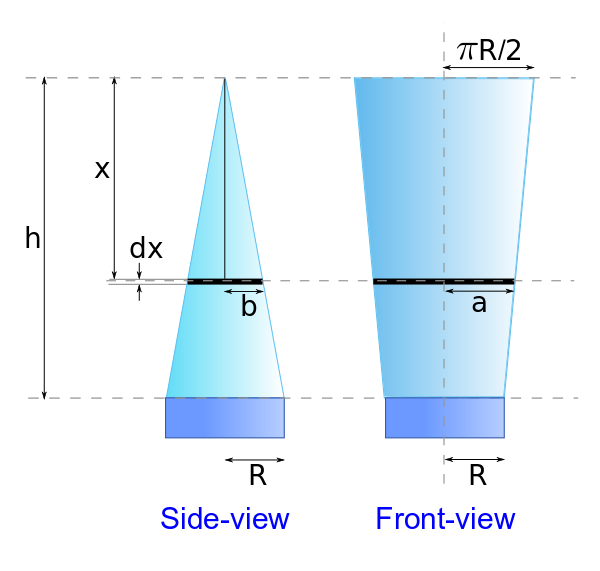
In part one, we looked at the ubiquitous tube and arrived at an approximate formula for its volume. We had neglected the effect of the increasing major axis on the volume and had taken it as a constant. Here, we shall try to be more accurate by including this tapering as well in our analysis.


For the elliptical cross section of the tube, let the major axis taper linearly from 2R to 3.14R as you move from the bottom of the tube to the top as shown above. The expression for the semi major axis 'a' at any vertical distance 'x' from the top is given by:

The expression for the semi minor axis 'b' at any vertical distance 'x' from the top is given by:


The volume of the tube can be obtained by the following integration.


Substituting the expressions for 'a' and 'b' and working out the integral we get


which is greater than the result obtained earlier.

Applying the result:
For the toothpaste tube under consideration in part one (R=1.6cm, h=13.8cm), the new formula gives a volume of 66.6 ml. Taking a correction factor of 1.5 to account for the bulging profile as opposed to a triangular one, we get a volume of about 100 ml. The choice of an appropriate correction factor is a matter of debate though. For a net weight of 150 gm, the density of the toothpaste would be 1.5 gm/ml as opposed to the earlier result of 2.5 gm/ml. This new result seems more in agreement with literature which says that typically it's in the range of 1.2-1.6 gm/ml.

Thanks to Raghunandan for pointing out an alternative approach to calculating the density of toothpaste coming from the chemical composition data.

Caveat:
Strictly speaking it is not correct to say that both major axis as well as minor axis taper linearly. Whatever be the values of 'a' and 'b', they have to satisfy the constraint that the perimeter of the ellipse has to equal 2 x pi x R (Since our tube was actually formed by pinching one end of a cylindrical tube). Hence, the moment you say that either 'a' or 'b' tapers linearly, the other has to taper non-linearly. But so far as an approximate calculation is concerned we shall not worry about this constraint.


Sunday, October 23, 2011

My experiments with toothpaste - I


Brushing my teeth on a Sunday morning I glanced upon the new toothpaste tube and wondered what's the volume of the paste in it. So many of our daily use pastes and gels - toothpastes, shaving creams, face-washes, ointments and many others - come in this weird shape that I don't have a name for. Let me call it the tube. The mensuration tables we all studied in school gave us the formulae for the volumes of common shapes such as cube, cuboid, sphere, cylinder, cone etc. But they didn't talk about this ubiquitous shape!

If you look at the horizontal cross section of a right circular cone, it starts out with a big circle at the bottom and as you move up, the circle becomes smaller and smaller till you finally reach a point. The cross section of the tube also starts out with a circle, but as you move up, one of the two principal axes of the circle starts shrinking (minor axis) while the other starts increasing (major axis). You end up with flatter and flatter ellipses finally reaching a line segment of length 3.14xR when the ellipse is completely flattened out at the top. 


Let us assume that the tube tapers off linearly and hence it should look like a triangle from the side view as shown above. Another simplifying assumption is to neglect the effect of the increasing major axis, hence taking it as a constant. As per this assumption the major axis stays at 2R throughout. In other words, the semi-major axis stays at R throughout. (A more accurate analysis taking into account the tapering of the major axis can be found in part two)

The volume of the elemental ellipse of thickness 'dx' located at a distance 'x' from the top is given by,


We get the total volume of the tube by integrating the above elemental volume for 'x' varying from 0 to h,


That's an intuitively pleasing result because it tells us that the volume of the tube is in between the volume of a cone and that of a cylinder having the same base radius and height.


Applying the result:
For the toothpaste tube I was using, R=1.6 cm and h=13.8 cm which gives a volume of about 55.5 ml as per the formula derived above. Since the tube is brand new, it's likely to have a bulging profile as opposed to the triangular one assumed above. So, the volume would actually be slightly larger than the calculated value. Let's take it as 60 ml. The net weight marked on the tube is 150 gm. Hence the density of the paste is (150 gm)/(60 ml) = 2.5 gm/ml, that's two and a half times the density of water.

No wonder, however small amount of toothpaste you put into water, it's bound to sink!