Showing posts with label toothpaste. Show all posts

Saturday, November 19, 2011

My experiments with toothpaste - II

In part one, we looked at the ubiquitous tube and arrived at an approximate formula for its volume. We had neglected the effect of the increasing major axis on the volume and had taken it as a constant. Here, we shall try to be more accurate by including this tapering as well in our analysis.
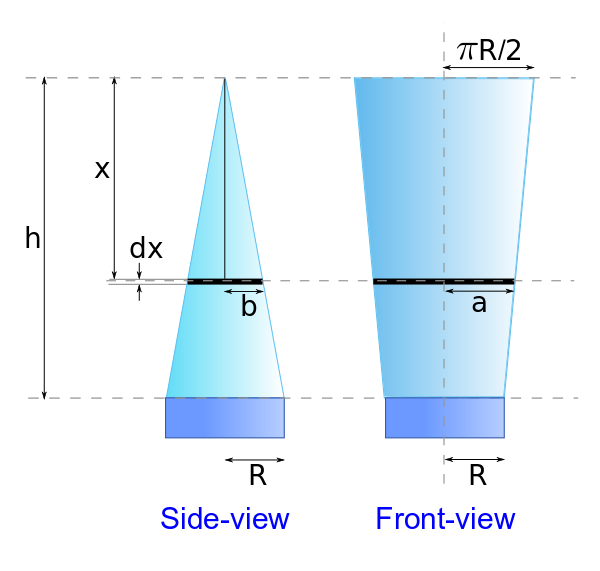

For the elliptical cross section of the tube, let the major axis taper linearly from 2R to 3.14R as you move from the bottom of the tube to the top as shown above. The expression for the semi major axis 'a' at any vertical distance 'x' from the top is given by:

The expression for the semi minor axis 'b' at any vertical distance 'x' from the top is given by:


The volume of the tube can be obtained by the following integration.


Substituting the expressions for 'a' and 'b' and working out the integral we get


which is greater than the result obtained earlier.

Applying the result:
For the toothpaste tube under consideration in part one (R=1.6cm, h=13.8cm), the new formula gives a volume of 66.6 ml. Taking a correction factor of 1.5 to account for the bulging profile as opposed to a triangular one, we get a volume of about 100 ml. The choice of an appropriate correction factor is a matter of debate though. For a net weight of 150 gm, the density of the toothpaste would be 1.5 gm/ml as opposed to the earlier result of 2.5 gm/ml. This new result seems more in agreement with literature which says that typically it's in the range of 1.2-1.6 gm/ml.

Thanks to Raghunandan for pointing out an alternative approach to calculating the density of toothpaste coming from the chemical composition data.

Caveat:
Strictly speaking it is not correct to say that both major axis as well as minor axis taper linearly. Whatever be the values of 'a' and 'b', they have to satisfy the constraint that the perimeter of the ellipse has to equal 2 x pi x R (Since our tube was actually formed by pinching one end of a cylindrical tube). Hence, the moment you say that either 'a' or 'b' tapers linearly, the other has to taper non-linearly. But so far as an approximate calculation is concerned we shall not worry about this constraint.


Sunday, October 23, 2011

My experiments with toothpaste - I


Brushing my teeth on a Sunday morning I glanced upon the new toothpaste tube and wondered what's the volume of the paste in it. So many of our daily use pastes and gels - toothpastes, shaving creams, face-washes, ointments and many others - come in this weird shape that I don't have a name for. Let me call it the tube. The mensuration tables we all studied in school gave us the formulae for the volumes of common shapes such as cube, cuboid, sphere, cylinder, cone etc. But they didn't talk about this ubiquitous shape!

If you look at the horizontal cross section of a right circular cone, it starts out with a big circle at the bottom and as you move up, the circle becomes smaller and smaller till you finally reach a point. The cross section of the tube also starts out with a circle, but as you move up, one of the two principal axes of the circle starts shrinking (minor axis) while the other starts increasing (major axis). You end up with flatter and flatter ellipses finally reaching a line segment of length 3.14xR when the ellipse is completely flattened out at the top. 


Let us assume that the tube tapers off linearly and hence it should look like a triangle from the side view as shown above. Another simplifying assumption is to neglect the effect of the increasing major axis, hence taking it as a constant. As per this assumption the major axis stays at 2R throughout. In other words, the semi-major axis stays at R throughout. (A more accurate analysis taking into account the tapering of the major axis can be found in part two)

The volume of the elemental ellipse of thickness 'dx' located at a distance 'x' from the top is given by,


We get the total volume of the tube by integrating the above elemental volume for 'x' varying from 0 to h,


That's an intuitively pleasing result because it tells us that the volume of the tube is in between the volume of a cone and that of a cylinder having the same base radius and height.


Applying the result:
For the toothpaste tube I was using, R=1.6 cm and h=13.8 cm which gives a volume of about 55.5 ml as per the formula derived above. Since the tube is brand new, it's likely to have a bulging profile as opposed to the triangular one assumed above. So, the volume would actually be slightly larger than the calculated value. Let's take it as 60 ml. The net weight marked on the tube is 150 gm. Hence the density of the paste is (150 gm)/(60 ml) = 2.5 gm/ml, that's two and a half times the density of water.

No wonder, however small amount of toothpaste you put into water, it's bound to sink!